
Here's what most of those numbers don't tell you: right now, more businesses are losing than gaining from AI use. And I've seen that firsthand.
Teams are shipping more AI-generated code than ever, and still struggling to turn that into faster delivery or better quality.
So how do you break that pattern?
It comes down to good implementation and management before chasing more adoption.
That's exactly where many development teams stall. Here are the 3 bottlenecks I see most often.
TL;DR
- Shadow AI is widespread: Employees use non-corporate accounts on corporate devices to access AI, and the number one thing they're feeding into those tools is source code.
- Inconsistent AI use across a dev team can cost time instead of saving it. One of House of Angular's clients recovered 10 hours a week just by unifying how their team used AI.
- AI has shifted the bottleneck from writing code to everything around it. Decisions, reviews, QA, and sign-offs now make up the majority of delivery time, and most businesses haven't adapted.
- AI generates more code, not better code. Code duplication and maintainability issues have been moving in the wrong direction for years, draining AI ROI through wasted tokens and costly reviews.
Bottleneck 1: Shadow AI
In Verizon Business' 2026 Data Breach Investigations Report, we read that 67% of employees use non-corporate accounts on their corporate devices to access AI services.
Pair that with the fact that in May–July 2026, 90% of polled developers used AI coding agents at work at least weekly, as reported by JetBrains Research.
That suggests most of the AI running through your dev team's daily workflow is likely happening completely off radar.
That's a problem we call "Shadow AI": using generative AI tools on corporate devices without the knowledge, approval, or oversight of the organization's IT or security team.
Shadow AI became the third most common non-malicious insider behavior flagged in Verizon's DLP data. The scale of it grew about 4 times compared to the previous year.
And the number one thing employees were feeding into external GenAI tools was… source code!
Your developers paste fragments of your project's source code into AI tools on unauthorized or private accounts, probably without realizing that each query is potentially your company's intellectual property walking right out the door.
Shadow AI has another drawback, too. Inconsistent AI use within development teams can cost time instead of saving it.
For example, our House of Angular team recently audited AI use for one of our European clients. We found that Shadow AI was widespread across their dev team. But once we unified how they used AI, they got back an extra 10 hours a week.
Bottleneck 2: Code ships fast, business moves at old speed
Before AI, coding speed was often the bottleneck. Now velocity isn't the problem, since AI noticeably speeds up shipping code.
The problem is that the business side of many projects hasn't caught up.
Here's a graph I made of a single development loop (like shipping one feature), based on what I've observed in different client projects:
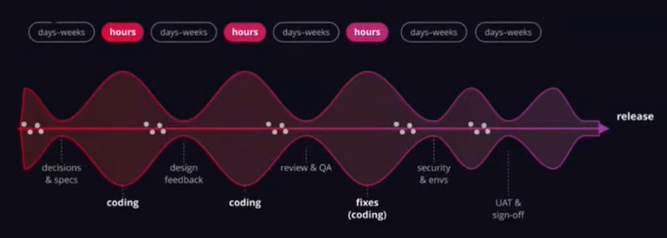
I noticed each coding phase usually takes just a few hours, speeding up the whole process. What stalls it are the moments in between: decisions, feedback, review, QA, sign-offs.
Many businesses simply can't keep pace with the code.
So what if you gained speed in producing code, if it simply gets bottlenecked elsewhere?
If the business processes in your project that influence development still look the same as before adopting AI, it's time to adapt.
For an example of what that looks like in practice, see how our team delivered a CRM with AI agents at every stage. Read our case study here.
Bottleneck 3: AI generates more code, not better code
AI works based on statistics. It copies patterns it sees and extends them, but it often doesn't truly understand your architecture. So while it generates code quickly, the quality can fall short of expectations.
GitClear's "The Maintainability Gap: AI Code Quality in 2026" found, across four years of code-change data, that maintainability signals have consistently moved in the wrong direction:
- within-commit copy/paste up 41% since 2023
- code block duplication up 81%
- error-masking constructs up 47%
- two-week code churn up 15%
CodeRabbit's December 2025 study adds to that picture: AI-generated code carries 1.7x more issues than code written by developers.
That's a real problem. Poor code quality makes things like code review harder and slower, which feeds straight into bottleneck 2, and it makes the codebase harder to maintain over time.
It can hurt your ROI, too. Every duplication adds unnecessary code to your codebase, and that code might go into context. More context means more tokens burned on every context-based task, which quietly drains your budget. That's why volume is the silent killer of AI ROI.
If you want to see the whole process, from fixing these bottlenecks to measuring whether AI pays off, read my full guide for decision-makers.
Conclusions
AI usually doesn't fail in dev teams because the tools are bad, but because of what happens around them: unapproved accounts, a business that can't keep up with the code, and a growing pile of mediocre output.
Sort out these three, and you'll be well on your way to adoption that actually pays off.
And if you're not sure where to start, let's talk. I'm doing free consultations where we can figure out where you're losing time and money, no strings attached.
Just book a spot in our calendar, and don't forget to add my name in the message so we know who you'd like to talk to. It's the fastest way to reach me, so I'll get back to you as soon as I can.